skip to main |
skip to sidebar
Our day was focused on the Karnak Temple, the largest sanctuary the world has ever seen. This is the temple at the other end of the 3 km-long road of sphinxes that leads from the Luxor Temple. Luckily, some pharoah-like transport had already been arranged. Fortunately for archaeologists, the outer walls of the Karnak Temple were never finished (temples were always built from the inside out, beginning with the most sacred, inner chamber). This provided evidence of how Egyptians built large walls and many other structures: piling rocks and sand up, to erect the wall, and gradually taking it away, finishing and inscribing the wall from the top down.


 The outer court was built to reflect a forest of palms. It is bewildering in scale, especially considering that it was built using only sand, water, mallets and man-power.

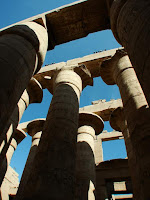 There are 134 "trees", which would have been covered by a roof of wood and stone.


The scarab, contrary to Hollywood depiction, is a symbol of fertility, fortune and survival. Walking around the statue 7 times, counter-clockwise, is meant to grant whatever wish is made. Yes, we did.
 Our last stop of the day was a perfumery, which supplies all the major international perfume houses.

Cairo is a city of conflicting descriptions. It is definitely the largest city in Africa, but it is rarely thought of as African. It shows definite signs of its population continuing to grow to over 16m, yet we were frequently surprised by the occasional quiet oasis. Most of all, however, it belongs to an area of the Nile whose history is dominated not only by the wonder of ancient civilization, but also by a long, rich and sometimes tumultuous periods of empire. Today, we saw some of the many sides of Cairo.
 The Mohammed Ali mosque, at the Citadel built by Salah al-Din.


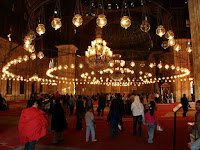
 Suleyman Pasha Mosque, the first Ottoman mosque built in Egypt.


In the evening, we were reminded again of the ancient history that has dominated the landscape where present-day Cairo stands. We were also reminded that it is impossible to go anywhere in the world and not hear pagpipes. The pharonic pipers were, without a doubt, the strangest ensemble of pipers we've seen. But our last view of Giza at night was the mysterious Sphinx.


 There are 134 "trees", which would have been covered by a roof of wood and stone.